Banner = Earth's Busy Neighborhood: Traffic Report
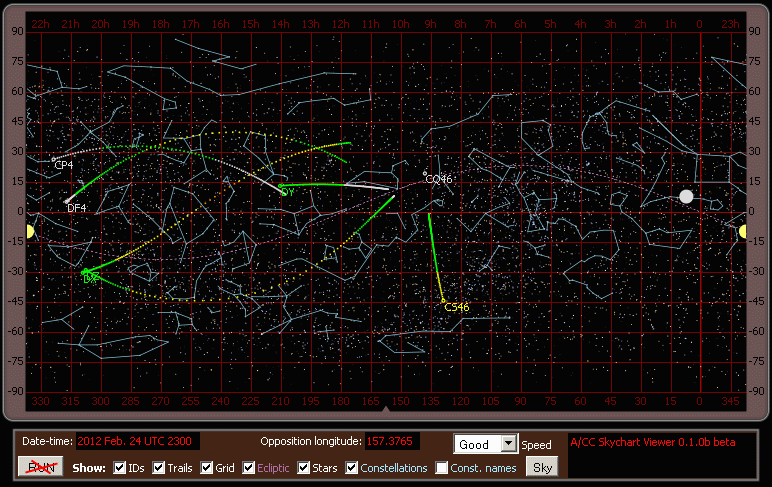
sky chart

Screen shot from an online interactive sky chart viewer under development at A/CC to show the paths of objects that are passing Earth at less than ten lunar distances (LD). Objects in white are outside ten LD at the date and time shown, green inside ten LD, yellow inside Earth's Hill Sphere, orange inside two LD, and red inside one LD of Earth -- all from JPL SSD Horizons data.
  -->   See more info and more screen shots.


Today's Traffic:  There are three objects known to be traveling within ten lunar distances (LD)1 of our planet today, May 9th. 2008 HU4 is departing, starting the day at 4.33 LD and finishing at 4.58 LD. 2008 HD2 is at 6.50-6.80 LD. It is coming its closest to Earth today on this passage, reaching 6.47 LD at 0458 UTC. And 2008 HR3 is at 9.83-6.60 LD.

One object is known to be approaching in the near future. 2008 BT18 (a planned radar target) will come inside ten LD on July 11th.

There are nine objects that recently flew past Earth at less than ten LD and remain of continuing interest. See their details below.

This report was refreshed at 1619 UTC. New data has been posted today for these objects: 2008 JL3, 2008 HR3, and 2008 HC38.


Illustration of ten lunar distances.

1. Ten lunar distances:  A "lunar distance" (LD) is the average distance between Earth and Moon (about 384,400 km.). Ten lunar distances has no special astronomical importance but is a useful arbitrary "bubble" within which to organize this report. An approach by a small Solar-System body starts to become interesting at less than four LD out from Earth as it encounters our planet's "Hill sphere" (distance indicated by the blue line in this illustration at about 3.9 LD). This is a region where the Earth exercises gravitational influence over passing objects and can change their orbital paths. The Moon also has a Hill sphere, outlined here as a gray circle. (The Earth and Moon are not shown to scale.)

2. Data credit:  All data on this page derived from orbit solutions comes from the NASA JPL Solar System Dynamics (SSD) Group through its Horizons system. All information about optical observations comes from the IAU Minor Planet Center (MPC) and info about radar observations comes from JPL SSD. NASA, JPL, and the MPC are not associated with this page or A/CC, and responsibility for the interpretation of this information and its use here rests entirely with A/CC. Important note: Approach times presented here as to-the-minute may have unstated uncertainties of a few minutes, or many minutes or even hours for objects with old or very short observation spans. Therefore, actual encounter distances may also vary, occasionally by as much as ten lunar distances. See JPL's Close Approach Tables for nominal vs. minimum possible passage distances and times and their note about uncertainties.

3. Size estimates:  Object diameters are rough approximations derived by standard formula from H, an object's "absolute magnitude" (brightness), where higher numbers represent dimmer (thus usually smaller) objects.


Details for Current Objects in Earth-Passage Order

2008 HU4   -   departing
Approximate diameter:7 meters (H=28.317)
Closest Earth approach:2.46 LD at 0116 UTC on 27 April
Inside Earth's Hill sphere:16 April until 7 May
Inside ten LD of Earth:20 March until 29 May
Data based on:JPL SSD orbit solution #5 downloaded 7 May
based on 36 observations spanning 5 days
Optical observation:observed from 6 locations during 5.2229 days
discovered at 0747 UTC on 30 April by the Catalina Sky Survey
last observed at 1308 UTC on 5 May by Tiki Obs.
Note:risk listed
2008 HD2   -   departing
Approximate diameter:33 meters (H=25.055)
Closest Earth approach:6.47 LD at 0458 UTC today
Inside ten LD of Earth:6 to 12 May
Data based on:JPL SSD orbit solution #6 downloaded 7 May
based on 25 observations spanning 7 days
Optical observation:observed from 5 locations during 7.1202 days
discovered at 0642 UTC on 27 April by the Mt. Lemmon Survey
last observed at 0935 UTC on 4 May by Mt. John Obs.
2008 HR3   -   approaching
Approximate diameter:36 meters (H=24.841)
Closest Earth approach:3.06 LD at 1615 UTC on 11 May
Inside Earth's Hill sphere:tomorrow until 12 May
Inside ten LD of Earth:yesterday until 14 May
Data based on:JPL SSD orbit solution #9 downloaded today
based on 54 observations spanning 9 days
Optical observation:observed from 9 locations during 9.5969 days
discovered at 0638 UTC on 29 April by the Mt. Lemmon Survey
last observed at 2058 UTC yesterday by Klet Obs.
Note:risk listed
2008 BT18   -   approaching
Approximate diameter:768 meters (H=18.222)
Closest Earth approach:5.87 LD at 1455 UTC on 14 July
Inside ten LD of Earth:11 to 17 July
Data based on:JPL SSD orbit solution #34 downloaded 18 April
based on 196 observations spanning 1955-2008
Optical observation:observed from 25 locations during 19391.9534 days
discovered at 0954 UTC on 31 Jan. by LINEAR
first observed at 0526 UTC on 14 March 1955 by Rob Matson via the Palomar Digitized Sky Survey
last observed at 0418 UTC on 16 April by the Catalina Sky Survey
Note:radar target


Recent Objects in Earth-Passage Order

  These objects either departed from ten LD during the last week or were reported observed.

2007 TU24   -   departed
Approximate diameter:299 meters (H=20.274)
Closest Earth approach:1.44 LD at 0834 UTC on 29 Jan.
Inside Earth's Hill sphere:27 to 31 Jan.
Inside ten LD of Earth:24 Jan. until 3 Feb.
Closest Moon approach:2.20 LD at 1540 UTC 29 Jan.
Data based on:JPL SSD orbit solution #72 downloaded 6 May
based on 654 observations spanning 2007-2008 including radar observation
Optical observation:observed from 60 locations during 206.8558 days
discovered at 0626 UTC on 11 Oct. 2007 by the Catalina Sky Survey
last observed at 0258 UTC on 5 May by Astronomical Research Obs.
Radar observation:observed 11 times from 3 locations during 10.3215 days
first observed at 2300 UTC 23 Jan. by Goldstone DSS-14 70m antenna
last observed at 0643 UTC 3 Feb. by Arecibo
Links:
2008 ED8   -   departed
Approximate diameter:54 meters (H=23.976)
Closest Earth approach:1.37 LD at 0826 UTC on 10 March
Inside Earth's Hill sphere:8 to 12 March
Inside ten LD of Earth:5 to 15 March
Closest Moon approach:2.21 LD at 0605 UTC 10 March
Data based on:JPL SSD orbit solution #8 downloaded 5 May
based on 155 observations spanning 57 days
Optical observation:observed from 17 locations during 57.1241 days
discovered at 0401 UTC on 8 March by LINEAR
last observed at 0700 UTC on 4 May by Astronomical Research Obs.
2008 FC   -   departed
Approximate diameter:38 meters (H=24.767)
Closest Earth approach:5.07 LD at 1806 UTC on 15 March
Inside ten LD of Earth:9 to 22 March
Data based on:JPL SSD orbit solution #7 downloaded 6 May
based on 52 observations spanning 43 days
Optical observation:observed from 7 locations during 42.8507 days
discovered at 0913 UTC on 23 March by the Catalina Sky Survey
last observed at 0538 UTC on 5 May by Astronomical Research Obs.
2008 GW20   -   departed
Approximate diameter:132 meters (H=22.053)
Closest Earth approach:5.99 LD at 1843 UTC on 4 April
Inside ten LD of Earth:1 to 8 April
Data based on:JPL SSD orbit solution #14 downloaded 7 May
based on 134 observations spanning 25 days
Optical observation:observed from 16 locations during 25.0588 days
discovered at 0855 UTC on 11 April by the Catalina Sky Survey
first observed at 0824 UTC on 11 April by LINEAR
last observed at 0948 UTC on 6 May by the Spacewatch 0.9m telescope
2008 HQ3   -   departed
Approximate diameter:11 meters (H=27.533)
Closest Earth approach:8.66 LD at 0804 UTC on 23 April
Inside ten LD of Earth:18 to 28 April
Data based on:JPL SSD orbit solution #3 downloaded yesterday
based on 22 observations spanning 7 days
Optical observation:observed from 3 locations during 6.9960 days
discovered at 0600 UTC on 29 April by the Mt. Lemmon Survey
last observed at 0554 UTC on 6 May by Astronomical Research Obs.
2008 HC38   -   departed
Approximate diameter:20 meters (H=26.106)
Closest Earth approach:2.18 LD at 0113 UTC on 28 April
Inside Earth's Hill sphere:27 to 29 April
Inside ten LD of Earth:24 April until 1 May
Closest Moon approach:1.33 LD at 0200 UTC 28 April
Data based on:JPL SSD orbit solution #6 downloaded today
based on 32 observations spanning 8 days
Optical observation:observed from 8 locations during 8.0249 days
discovered at 0709 UTC on 30 April by LINEAR
last observed at 0745 UTC yesterday by the Spacewatch 1.8m telescope
Note:risk listed
2008 JQ   -   departed
Approximate diameter:27 meters (H=25.46)
Closest Earth approach:6.92 LD at 1031 UTC on 29 April
Inside ten LD of Earth:25 April until 3 May
Data based on:JPL SSD orbit solution #5 downloaded 7 May
based on 38 observations spanning 4 days
Optical observation:observed from 7 locations during 3.9761 days
discovered at 0713 UTC on 2 May by LINEAR
last observed at 0639 UTC on 6 May by Astronomical Research Obs.
Note:risk listed
2008 JC   -   departed
Approximate diameter:17 meters (H=26.481)
Closest Earth approach:2.48 LD at 1558 UTC on 29 April
Inside Earth's Hill sphere:28 to 30 April
Inside ten LD of Earth:26 April until 2 May
Data based on:JPL SSD orbit solution #2 downloaded 4 May
based on 19 observations spanning 2 days
Optical observation:observed from 4 locations during 1.9753 days
discovered at 0647 UTC on 1 May by the Catalina Sky Survey
last observed at 0612 UTC on 3 May by Astronomical Research Obs.
2008 JL3   -   departed
Approximate diameter:29 meters (H=25.303)
Closest Earth approach:5.13 LD at 2049 UTC on 30 April
Inside ten LD of Earth:26 April until 5 May
Data based on:JPL SSD orbit solution #3 downloaded today
based on 28 observations spanning 1 day
Optical observation:observed from 7 locations during 1.1062 days
discovered at 0825 UTC on 5 May by LINEAR
last observed at 1058 UTC on 6 May by Mt. John Obs.
Note:risk listed


http://www.HohmannTransfer.com
Publisher info, privacy & disclaimer
This page is © Copyright 2007-2008 Columbine, Inc. - All Rights Reserved
Do NOT copy, mirror, or embed this Web page, which is subject to frequent change, but please do link to it and let others know about it. Individuals may make snapshot copies for their own personal offline use.
Please report broken links or other problems with this page to <webmaster@hohmanntransfer.com>.